


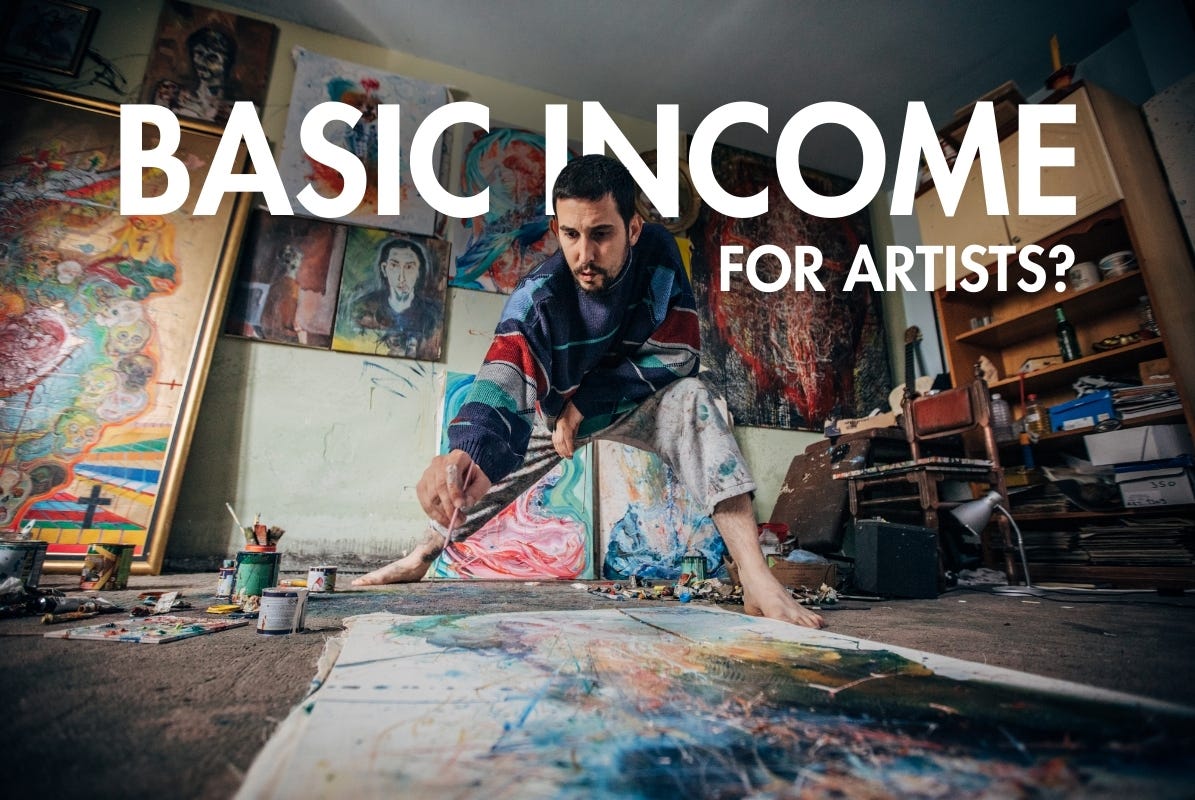
The myth of the starving artist suggests that artists and creative professionals are meant to endure poverty to produce authentic, meaningful work.
Similar to the phrase of “pulling yourself up by the bootstraps,” these cultural narratives romanticize financial struggle as a rite of passage towards success. And to achieve success, all you need is personal grit and to just try a little harder…
Both the myth and phrase tend to disregard the necessary resources or systematic support that can lead to artistic success.
According to a study by Karol Jan Borowiecki, an economist at the University of Southern Denmark, a person with a $100,000 family income is twice as likely to become a professional artist as someone earning $50,000, while those from $1 million households are nearly ten times more likely than those from $100,000 ones.1
Meilan Solly from the Smithsonian magazine writes, “Major obstacles for individuals in creative fields include high entry costs and low financial return.”2 Art schools charge high tuition. Entry-level jobs pay little. Internships pay little (if at all). Portfolios take time to build. Income can be inconsistent. Obstacles are abundant to those without a financial foundation.
“Devoting yourself to the life of a ‘starving artist’ is a lot less risky if your family has enough money to make sure you don’t actually starve.”
- Kristen Bahler (Money)
A Permanent Basic Income Program for Artists Funded by the Government?!
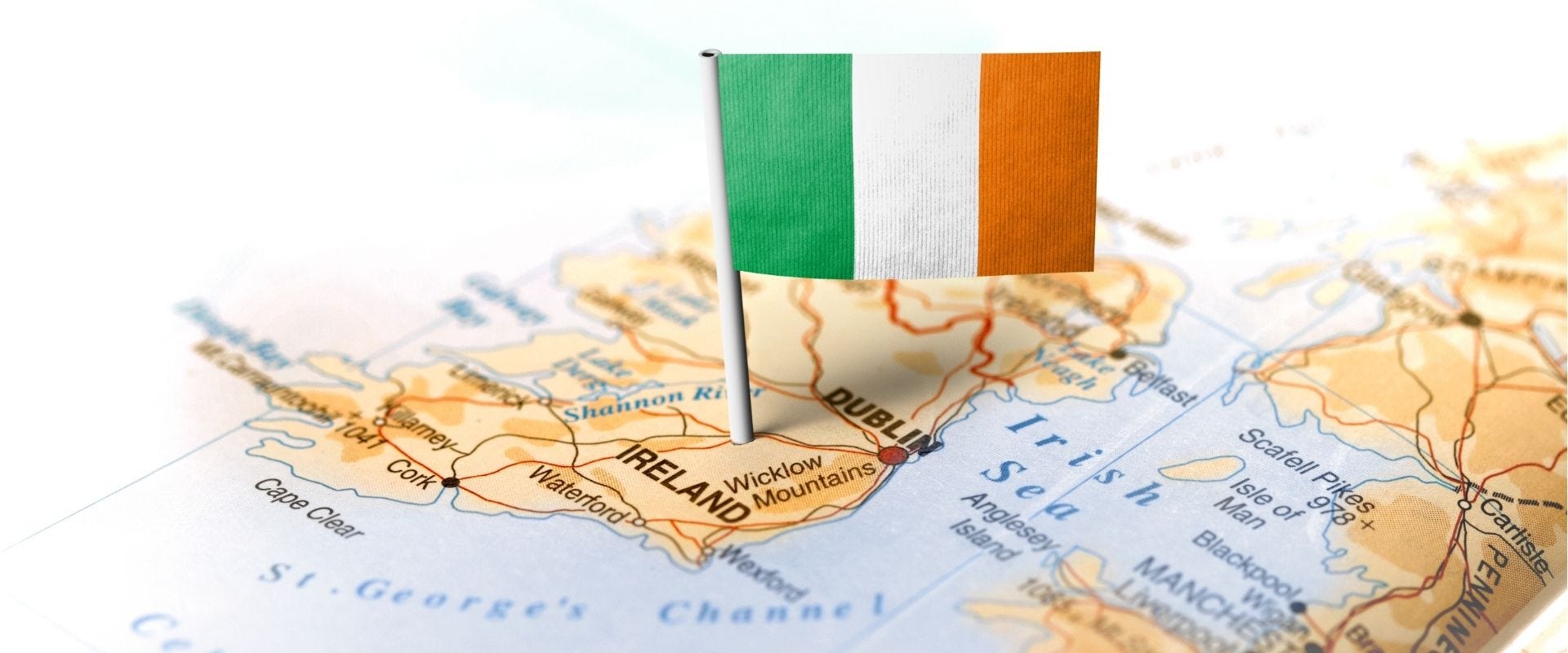
From 2022 to 2025, Ireland conducted the Basic Income for the Arts (BIA) pilot scheme, which provided 2,000 artists, drawn from a lottery system, a basic income of €325 a week (around $380). Designed to help the arts and culture sector recover after the COVID-19 pandemic, the program’s main objective was “to address the financial instability faced by many working in the arts.”3
Patrick O’Donovan, Ireland’s culture minister, calls it “the envy of the world.” He states, “The economic return from this investment in Ireland’s artists and creative-arts professionals has an immediate positive impact on the sector and on the economy in general. [It was important to keep the arts sector] resilient, sustainable, progressive, and accessible.”4
Ireland’s approximately €100 million investment paid off. For every €1.00 (around $1.18) invested, the pilot returned €1.39 (around $1.64) to the wider economy through tax revenue, welfare savings, and broader social benefits, according to a government-commissioned cost-benefit analysis.5
Due to the success of the three-year pilot, the Irish government extended it. Not as a pilot but as a permanent program.
“In recent years, some proponents of basic income have focused their efforts on providing regular financial support to artists, who can spend months or years working on unpaid creative projects. In New York, a private organization called Creatives Rebuild New York supported 2,400 creatives with $1,000 a month for three years following the pandemic.
Ireland’s program stands out because it’s both government-funded and—as of [October 2025]—permanent.”
- Ella Fieldman (Smithsonian Magazine)

What Would a Basic Income Mean For the Artists in Your Life (including yourself)?
The value of investing on the time and labor of creative professionals varies online:


Depending on your lived experiences and personal perspective on artistic careers, you may receive the news of Ireland’s BIA differently from the person next to you. You could be an artist yourself, a supporter of the arts, or maybe you rarely engage with the arts at all.
As the Bootstraps docuseries team, we work in a creative industry. Our team is made up of artists who have dedicated our time towards telling stories through the medium of documentary work. So we would love to know:
Would you pursue art as a career if you had a basic income? If so, what type of art?
Karol Jan BOROWIECKI, 2019. "The Origins of Creativity: The Case of the Arts in the United States since 1850," Trinity Economics Papers tep0219, Trinity College Dublin, Department of Economics.
Wealth Is a Strong Predictor of Whether an Individual Pursues a Creative Profession (Smithsonian Magazine)
Basic Income for the Arts (Citizens Information)
Irish Government Proposes Basic Income for Artists (Scott Santens)
Cost-benefit analysis for the Basic income for the Arts: Prepared for the Department of Culture, Communications, and Sport (Alma Economics)